
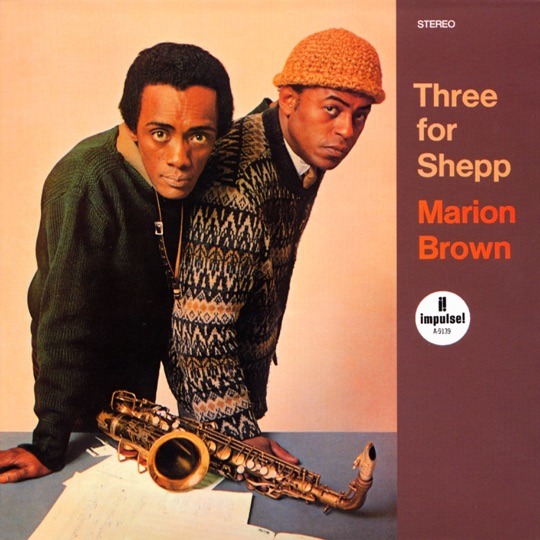
Marion Brown’s 1966 Three For Shepp captures avant-garde jazz’s creative intensity on Impulse! Records vinyl
Marion Brown’s album, released in 1966 on the landmark jazz label Impulse! Records, represents a significant milestone in avant-garde jazz and free jazz developments of the mid-1960s. As Brown’s debut as a bandleader, this record articulates a compelling sonic narrative that blends post-bop sensibilities with the untamed energy of free jazz. The album skillfully balances Brown’s own compositions with tunes by tenor saxophonist Archie Shepp, whose work had already begun to define a politically charged and emotionally intense strand of jazz. Featuring a sextet that includes notable figures like trombonist Grachan Moncur III, pianist Dave Burrell, bassist Norris Jones, and drummer Beaver Harris, the album captures the exploratory spirit tied to the socio-political landscape of the era, particularly resonating with the themes of the black revolution in America.
This release holds a prominent place not only in Marion Brown’s discography but also within the broader avant-garde jazz oeuvre of the 1960s, providing a lens through which to view jazz’s evolving language during a time of considerable artistic innovation. Brown had previously collaborated with key figures such as Ornette Coleman and Sun Ra, embedding him firmly in the vanguard of progressive jazz thought. Here, Brown’s alto saxophone delivers a signature lyrical quality that is at once personal and emblematic of the decade’s exploratory zeal. The album’s intricate interplay and dynamic range owe something to the work of contemporaries like Archie Shepp himself, as well as to the impressionistic textures often found in the music of John Coltrane and Pharoah Sanders, artists with whose approaches Brown’s work shares both emotive urgency and structural openness.
The tracklist further reinforces the album’s dual commitment to originality and homage. Brown’s three originals intertwine with three Shepp compositions, reflecting a creative dialogue that invokes Shepp’s earlier project which paid tribute to John Coltrane. The compositions unfold in a manner that juxtaposes intense, fiery passages against more introspective, nuanced moments, conveying the complex emotional terrain of the time. Pieces such as “The Shadow Knows” and “West India” demonstrate a keen sensitivity to spatial dynamics and rhythmic freedom, inviting comparisons to the loosely structured yet profoundly communicative expressions found within the works of contemporaries like Albert Ayler and Archie Shepp’s own explorations of avant-garde textures and political message.
Marion Brown’s work on this record has been recognized as a vital statement, one that continues to sound fresh and significant almost six decades after its initial release. The album not only encapsulates the ethos of the period’s jazz avant-garde but also charts emerging trajectories that anticipated the fusion of jazz with experimental modalities and cultural critique. As a product of Impulse! Records, a label synonymous with pioneering jazz artists and innovations, notably John Coltrane, this album fits naturally within a catalog that advanced the boundaries of jazz expression both artistically and commercially. Collectors and enthusiasts seeking to deepen their exploration of free jazz and post-bop will find this record essential, especially on vinyl, where its textured soundscape can be fully appreciated.
The sensibility of the album aligns with a broader movement in jazz that embraced political consciousness and artistic experimentation simultaneously, placing Marion Brown among a cohort of musicians who challenged conventions and expanded jazz’s narrative capacity. His voice as an alto saxophonist merges the lyricism of Ornette Coleman’s innovations with the raw expressivity associated with Sun Ra’s cosmic vision, while his compositions suggest melodic and rhythmic adventurousness akin to that found in the works of contemporaneous peers such as Pharoah Sanders. This record resonates with listeners attuned to jazz’s most daring chapters and will appeal to those following the legacy of independent labels that fostered groundbreaking new music releases during the transformative 1960s.
Originally pressed on vinyl in the mid-1960s and subsequently reissued through various channels, including in digital formats by Verve Reissues, the album maintains its status as a key historical document. Its significance extends beyond Marion Brown’s individual profile, exemplifying how jazz of the era responded to both musical and societal upheavals. For connoisseurs of jazz history and collectors hunting for influential LPs from the free jazz and post-bop movements, this album remains an indispensable entry, echoing the spirit of innovation and resistance that continues to inspire contemporary artists and listeners alike.
Learn more about Marion Brown